MITM (Man-in-the-Middle)
A man-in-the-middle (MITM) is anything that sits between you and a website and can read or change the traffic, whether as an attack, as company policy or as a service you chose.
Explanation
In depth
HTTPS is designed to stop interception. The site proves its identity with a certificate from a public authority your device already trusts, and the browser warns you if anything else answers. A man-in-the-middle gets around that in one of three ways. An attacker can trick you into ignoring the certificate warning. An organisation can install its own root certificate on managed laptops so its firewall can decrypt and re-encrypt traffic; that is normal in companies and schools. Or a government can ask everyone to install one. Kazakhstan did that in July 2019, and in August 2019 Mozilla and Google blocked that certificate in their browsers. A web proxy is a man-in-the-middle you chose, and it does not need a fake certificate. Your browser connects to the proxy's own domain, and the proxy opens a second, separate HTTPS connection to the site. AnyProxy's privacy policy says this plainly: the operator handles the decrypted content between those two connections. So the proxy can technically see what you read and type. That is why you should not log in to sensitive accounts through any web proxy you do not trust.
In practice
MITM (Man-in-the-Middle) in the real world
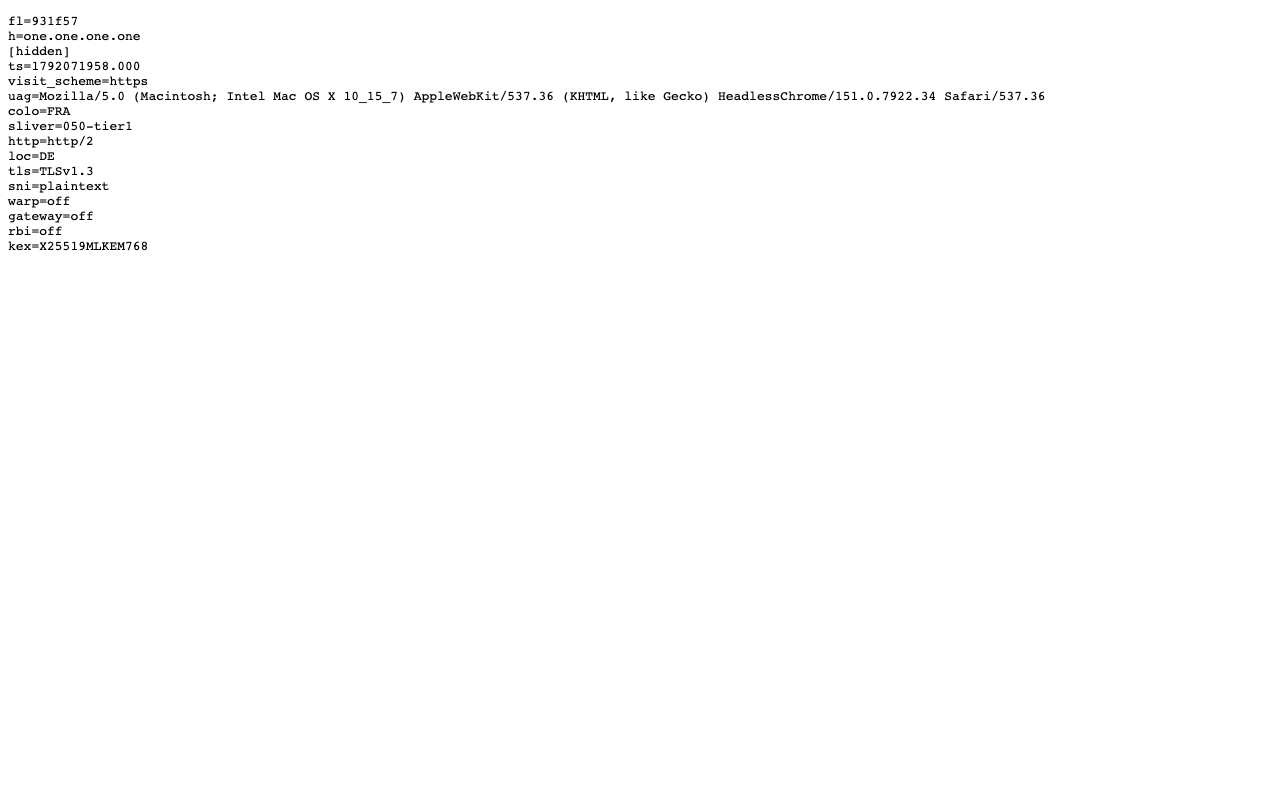
The two-connection design is visible in a trace. Opened through AnyProxy Frankfurt on 15 Oct 2026, Cloudflare's trace page saw a TLS 1.3 connection from the proxy server, located in DE, not from the visitor. Your browser's connection ends at fr.anyproxy.site, which holds its own Let's Encrypt certificate, so no warning appears and no fake certificate is involved. That is honest, but it also means the proxy is a point where pages exist unencrypted.
Sources: Mozilla Security Blog — Protecting our users in Kazakhstan (21 Aug 2019) · AnyProxy privacy and data handling · Cloudflare trace page used in the tests
We checked
The second, separate connection a web proxy makes (15 Oct 2026)
Questions about MITM (Man-in-the-Middle)
Related terms