“Use a VPN” is the default advice for opening a blocked page. For one page in a browser tab, often on a device where you cannot install anything, a web proxy is the lighter option: nothing to install, nothing to configure, and it works from any browser.
This guide covers how it works, when a proxy is the better choice, when it is not, and what failed in our own tests.
What a web proxy is, and why it works without a VPN
A web proxy is a website that fetches other websites for you. You open the proxy, type the address of the blocked site, and the proxy loads that site from its own server and passes the page back to your tab.
Your device is talking to AnyProxy’s servers, not to the blocked site. That gets around the three common ways a network blocks a site:
- DNS block — the network’s resolver refuses to look up the blocked name. You never ask it to; you ask for anyproxy.site.
- IP block — the firewall drops traffic to the site’s addresses. Your traffic goes to AnyProxy’s addresses instead.
- Hostname (TLS SNI) filtering — the firewall reads the site name in the encrypted connection’s setup. The name it sees is AnyProxy’s regional server, such as
sg.anyproxy.site.
What a proxy does not get around: a filter that blocks anyproxy.site itself. Many filtering products have a “proxy” or “anonymiser” category, and the network can log that you connected to AnyProxy even when it does not block it.
The flow, on any device
- Open anyproxy.site in any browser.
- Type the blocked site’s address —
youtube.comis enough. - Pick a region and press Open. The site loads in the same tab.
AnyProxy opens the site you name, on its home page. If you paste a link to a specific video or article, you land on that site’s home page and navigate from there. That is deliberate: it stops anyone from handing out a ready-made proxy link to a fake login page.
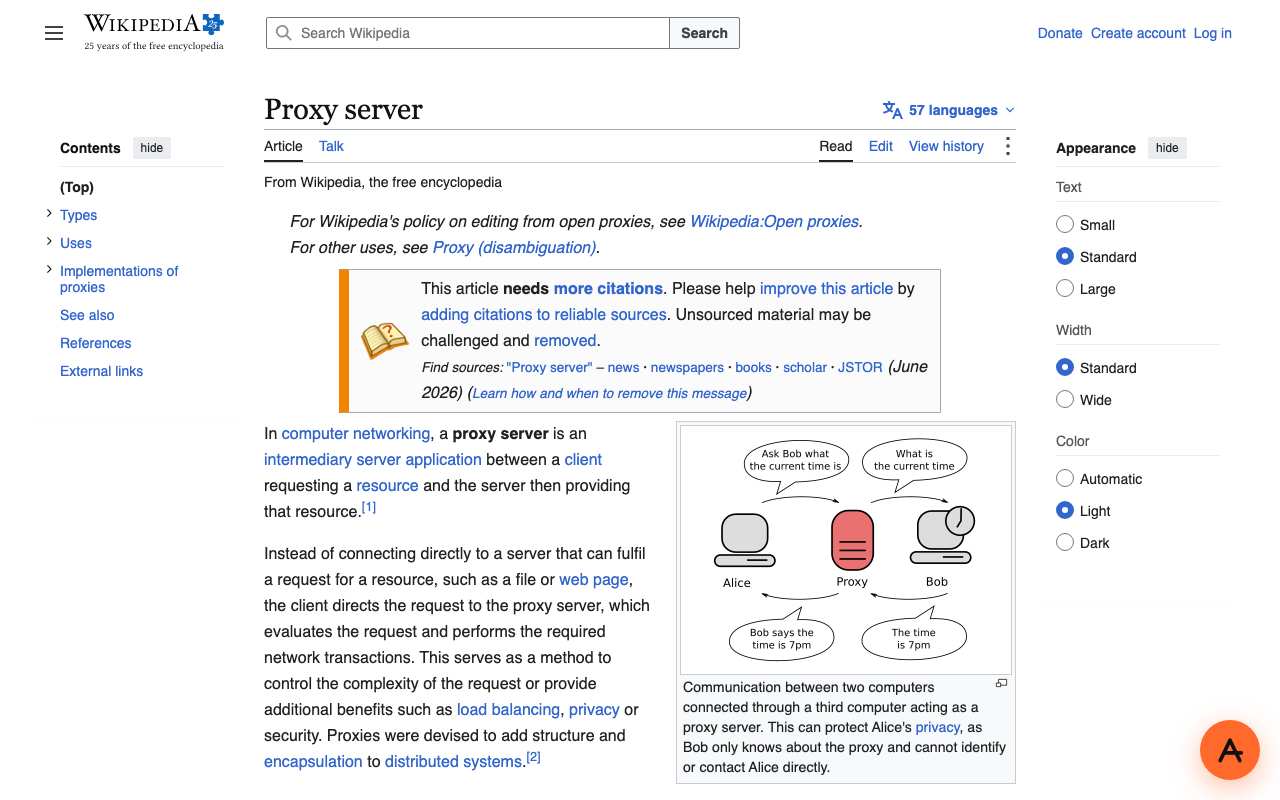
Wikipedia through AnyProxy Singapore, 15 October 2026. AnyProxy adds only the round button in the corner; there is no toolbar over the page.
No app installs, no account and no settings change on your device. The free regions are Singapore, Frankfurt and Virginia; Pro adds Tokyo and Los Angeles. Pick the one nearest to you: from India on 15 October 2026, a Wikipedia page took a median 1.4 s through Singapore and 3.7 s through Virginia.
Web proxy vs VPN — when to use which
| Situation | Web proxy | VPN |
|---|---|---|
| One page in one browser tab | Good fit | Works, but more setup |
| Device where you cannot install apps | Works, if the proxy is not blocked | Cannot be installed |
| Every app on the device, not just the browser | Not covered | Good fit |
| Video calls, games, torrents, other apps | Not covered | Good fit |
| Paid streaming (Netflix, Disney+) | Not tested; needs an account and region licence | Often detected and refused |
| Cost | Free tier | Usually paid |
The short version: use a proxy for a page, a VPN for a device.
For the long version, see proxy vs VPN.
What about public DNS or DNS-over-HTTPS?
Switching to a public resolver such as 1.1.1.1 or 8.8.8.8 gets around a DNS-only block and nothing else. If the network also blocks by IP address or by hostname, changing DNS will not help. A web proxy covers all three, because the blocked site’s name and address never leave your device.
Sites that did not open, even through the proxy
A proxy changes the route, not the site’s own rules. In our tests on 15 October 2026:
- Reddit showed “You’ve been blocked by network security” through all three free regions.
- Google Search answered with an “unusual traffic” reCAPTCHA page.
- Instagram redirected public profiles to its login page.
- ChatGPT loaded in Virginia and Singapore but stayed on a Cloudflare check in Frankfurt.
When a site refuses proxy traffic, switching proxy rarely helps. See fix proxy not loading for how to tell these cases apart.
When the proxy itself is blocked
If anyproxy.site does not load at all, the network you are on is probably blocking it, often through a “proxy avoidance” category in its filter.
- Check on mobile data. If anyproxy.site loads there, the block is on the Wi-Fi.
- On a work or school network, that block is the organisation’s decision. Ask the administrator if you have a legitimate need; see unblock a site at work.
Sites people commonly open this way
- Video and social: YouTube, TikTok, Instagram, X, Facebook.
- AI tools: ChatGPT.
- Messaging: WhatsApp Web, Telegram, Discord.
Each page lists our dated test results for that site, including what failed.
After the blocked page loads
Read the page, do what you came for, close the tab. Proxied addresses stay in your browser history like any other page, and they include the real site’s address in encoded form; a private window keeps them out of history. AnyProxy is not a no-logs service: it can record destination hosts and session details, as the privacy page explains.
For more on what we do and do not record, see is AnyProxy safe?.