Internet filtering in 2026 varies enormously by country, from Brazil, where national blocks are rare and short, to China’s Great Firewall. This page covers 14 countries: what is blocked, how the block is enforced where a source documents it, and what that means for a web proxy.
How we checked. Statuses come from OONI web-connectivity measurements run by volunteers inside each country between 15 July and 15 October 2026, plus dated news and rights-group sources. OONI calls a test “confirmed” when it sees a known block page or filtering answer; an “anomaly” is a failed load that may or may not be censorship. We quote success rates and counts, not verdicts. Where we had no 2026 measurement for a country, we say so. Our own tests through AnyProxy are from 15 October 2026.
Users are responsible for compliance with local law. This is a technical description, not legal advice; see proxy legality around the world.
China (Great Firewall)
Blocked: Almost every big Western platform. In OONI tests from China between 15 July and 15 October 2026, Google loaded in 1.1% of 190 tests, YouTube in 3.0% of 2,890, Wikipedia (Arabic edition) in 0.6% of 163, and Instagram, X, Facebook, WhatsApp, Telegram, Reddit, Discord, ChatGPT and the BBC each stayed under 10%. Reuters (6.0% of 234), Twitch (3.2%) and SoundCloud (4.6%) were blocked too. Bing (98.9% of 177), Yandex (98.1%) and Amazon loaded normally. Full country page: /unblock/from/china/.
How: Blocking runs nationally at the border gateways, so the low success rates look the same on China Telecom, China Unicom, China Mobile and the education network CERNET. OONI documented DNS injection and SNI filtering for every Wikipedia language edition from April 2019 (OONI, 14 May 2019). The firewall rarely serves a block page, so OONI records “anomalies” rather than “confirmed” blocks: read the success rate. On 20 August 2025 it injected forged TCP resets into every port-443 connection for about 74 minutes, cutting most HTTPS traffic in and out of the country (GFW Report, 20 Aug 2025). Since April 2024 orders have also reached app stores: Apple removed WhatsApp, Threads, Telegram and Signal from its China store (Caixin, 19 Apr 2024).
What we saw through AnyProxy: On 15 October 2026 a Wikipedia article and a YouTube video loaded through the Singapore server. Google Search did not: it showed Google’s own reCAPTCHA from both the Singapore and US servers. During an event like the August 2025 reset, no HTTPS service outside China works, AnyProxy included. China-specific guide: WhatsApp in China.
Iran
Blocked: In OONI tests from Iran between 15 July and 15 October 2026, YouTube (4.6% of 13,572), Instagram (3.1%), X (2.6%), Facebook (4.1%), TikTok, Telegram (4.0%), WhatsApp (5.6%), Signal, Reddit, Discord, Snapchat, Vimeo, the BBC (3.5%), Netflix and Twitch were confirmed blocked, with thousands of block-page answers each. Telegram and WhatsApp are blocked as thoroughly as YouTube, not “partially”. By contrast ChatGPT (99.4% of 479), Claude, Gemini, Perplexity, Google, Wikipedia, Reuters and Al Jazeera loaded normally at the network level. If an AI chatbot refuses you in Iran, that is the service limiting the country, not the filter. Full country page: /unblock/from/iran/.
How: Iranian networks return recognisable filtering answers, which is why OONI counts most failures as “confirmed”. The Supreme Council of Cyberspace makes blocking decisions; since August 2026 new restrictions also need the president’s approval (Iran International, 10 Aug 2026). 2026 was dominated by shutdowns: one began on 8 January during protests (IODA, 21 Jan 2026), and when partial access returned in late May after more than 2,000 hours, YouTube, Instagram, Telegram, WhatsApp and Facebook stayed blocked, and IPv6 and HTTP/3 were blocked (Al Jazeera, 31 May 2026).
What we saw through AnyProxy: On 15 October 2026 a YouTube video, BBC News Persian and a public Telegram channel preview loaded. Instagram sent an anonymous profile view to its login page. During a national shutdown, no outside service works, AnyProxy included. See also proxy vs VPN in Iran and the best proxies in Iran ranking.
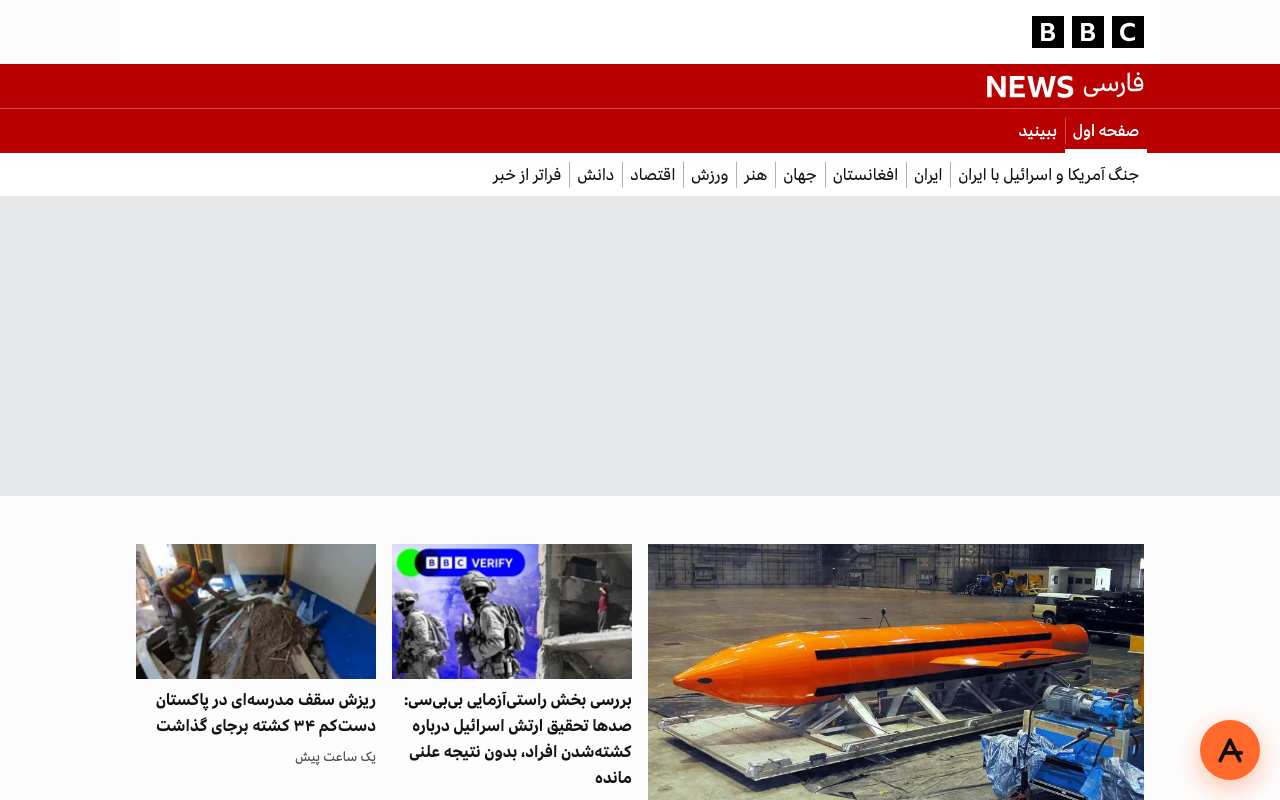
Caption: BBC News Persian (bbc.com/persian), blocked in Iran per OONI, through AnyProxy Singapore, 15 Oct 2026. The grey block is an empty ad slot.
Russia (Roskomnadzor)
Blocked: Facebook (from 4 March 2022) and Instagram (from 14 March 2022) (OPB/AP, 11 Mar 2022); Google News since March 2022 (Interfax, 23 Mar 2022); Discord since 8 October 2024 (The Record, 9 Oct 2024); Snapchat and FaceTime since 10 October 2025 (Al Jazeera, 5 Dec 2025). Roskomnadzor began slowing Telegram nationwide in February 2026 (Meduza, 10 Feb 2026), and WhatsApp said the same month that Russia had tried to block it fully (Bloomberg, 12 Feb 2026). We did not pull 2026 OONI data for Russia for this page. Full country page: /unblock/from/russia/.
How: Roskomnadzor orders blocks and has powers to block VPNs that do not filter its blocklist (law in force since 1 November 2017). Reuters described a stepped-up VPN crackdown in March 2026 (Reuters, 31 Mar 2026); see also our Russia VPN crackdown post. Since 1 September 2025, knowingly searching for “extremist” material, including through a VPN, can be fined.
What works: Not tested from inside Russia. Some services also limit Russia from their own side: Spotify suspended its service there in April 2022 (Axios, 25 Mar 2022), and a proxy cannot change a service’s own country rules.
Turkey (BTK)
Blocked: Discord since 9 October 2024 after an Ankara court decision (Bloomberg, 9 Oct 2024). Wikipedia was blocked from 29 April 2017 until January 2020, when access returned after the Constitutional Court ruled the ban unconstitutional (Al Jazeera, 16 Jan 2020). In OONI tests from Turkey between 15 July and 15 October 2026, YouTube (99.4% of 14,761), English Wikipedia (520 of 522), Reuters, Al Jazeera, Amazon and Claude all loaded normally. Full country page: /unblock/from/turkey/; see also Wikipedia from Turkey and YouTube from Turkey.
How: Blocks are ordered by courts and the telecoms authority under Law No. 5651, which was the basis of the 2017 Wikipedia block (Turkey Blocks, 29 Apr 2017).
What works: For the platforms above, nothing extra is needed as of October 2026. A Turkish Wikipedia article and search loaded through AnyProxy on 15 October 2026.
Pakistan (PTA)
Blocked: X was blocked from 17 February 2024, around the general election, until 7 May 2025 (Global Voices, 26 Feb 2024; TechRadar, May 2025). The PTA degraded and then blocked Wikipedia from 1 to 6 February 2023 (OONI, 15 Feb 2023). In OONI tests from Pakistan between 15 July and 15 October 2026, English Wikipedia (1,230 of 1,257), the BBC (9,435 of 9,775) and Gemini loaded normally. Full country page: /unblock/from/pakistan/; see also Wikipedia from Pakistan and BBC from Pakistan.
How: The PTA orders blocks. In 2024 it asked users to register VPNs by 30 November but did not enforce the deadline; in December 2024 its chairman said no VPN had been blocked (Arab News).
What works: For the sites above, nothing extra is needed as of October 2026.
Indonesia (Komdigi, formerly Kominfo)
Blocked: Site-specific blocks under the private electronic system operator (PSE) rules. DuckDuckGo was blocked in August 2024 over gambling and pornography in its results (SCMP/Reuters, 2 Aug 2024). Reddit was unblocked in July 2026 after about 11 years, once it registered as a PSE (Antara, 3 Jul 2026). In OONI tests between 15 July and 15 October 2026, Instagram (99.3% of 19,137), WhatsApp (99.2%), Google and The Guardian loaded normally. Full country page: /unblock/from/indonesia/.
How: The ministry orders blocks and ISPs enforce them. We did not verify the technique per ISP for this page.
What works: Most of the big platforms load directly. Note that DuckDuckGo showed its own anti-bot challenge for searches through AnyProxy on 15 October 2026, so a proxy does not make it usable either. Our Indonesian-language pages cover this market.
Saudi Arabia (CST, formerly CITC)
Blocked: A content filter covers material deemed against public morality. VoIP apps such as Skype and WhatsApp calling were banned until 20 September 2017, when the government lifted the ban for services meeting its rules and said calls would be monitored (Engadget, 20 Sep 2017). In OONI tests between 15 July and 15 October 2026, X loaded normally (98.3% of 3,223). Full country page: /unblock/from/saudi-arabia/.
How: We did not find a current primary source on the filtering technique, so we do not describe one.
What works: For X, nothing extra is needed as of October 2026. Our other OONI data for Saudi Arabia had too few tests to judge.
UAE (TDRA)
Blocked: WhatsApp voice and video calls, because only licensed operators may offer VoIP (Khaleej Times, 23 Jun 2017). WhatsApp itself is not blocked: in OONI tests between 15 July and 15 October 2026, whatsapp.com loaded in 2,274 of 2,314 tests, Instagram in 2,561 of 2,616 and TikTok in 2,309 of 2,370, with no confirmed blocks. Full country page: /unblock/from/uae/; see also WhatsApp, Instagram and TikTok from the UAE.
How: The UAE regulates content and VoIP licensing more than platform access. Federal Decree-Law 34 of 2021 fines manipulating an IP address to commit or hide a crime.
What works: A web proxy cannot carry app voice calls. WhatsApp Web loaded its login QR code through AnyProxy on 15 October 2026; calls were not tested.
Egypt (NTRA)
Blocked: Mainly news and rights sites. Rights outlet Manassa counted more than 600 blocked sites, including over 100 news outlets, since 2017 (Manassa, 20 Jan 2026). In OONI tests between 15 July and 15 October 2026, Al Jazeera loaded in 42% of 448 tests: almost never on Telecom Egypt (2 of 86) and about half the time on Vodafone. YouTube, Facebook, WhatsApp, Telegram and Signal loaded in 95–98% of tests. WhatsApp calling remained inaccessible as of May 2025, per Freedom House (Freedom on the Net 2025). Full country page: /unblock/from/egypt/.
How: OONI’s 2018 study found blocking mainly by deep packet inspection that resets the connection, with no block page, so a blocked site just looks broken (OONI, 2 Jul 2018).
What we saw through AnyProxy: On 15 October 2026 Al Jazeera, Reporters Without Borders and Alhurra all opened.
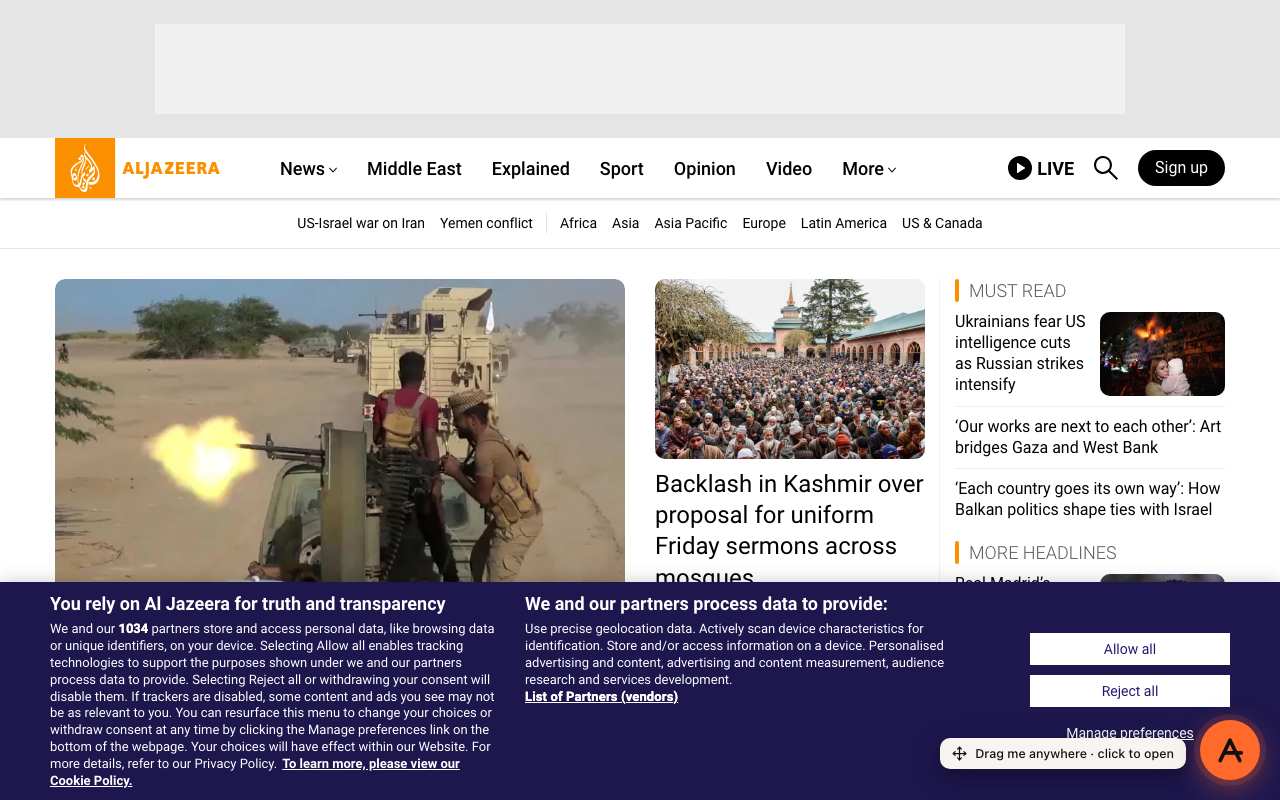
Caption: Al Jazeera English through AnyProxy Frankfurt, 15 Oct 2026. The consent banner appears because Frankfurt is an EU exit.
Vietnam
Blocked: Telegram, which the telecom department ordered blocked on 21 May 2025 (RFA, 23 May 2025). Facebook is not blocked: OONI recorded 7,536 of 7,566 tests loading normally between 15 July and 15 October 2026, and YouTube 7,606 of 7,635. Vietnam did slow Facebook once, for about seven weeks in February–March 2020, by taking its local servers offline (Al Jazeera, 22 Apr 2020). Full country page: /unblock/from/vietnam/; see also Facebook and YouTube from Vietnam.
How: Pressure is mostly on content. Decree 147/2024, in force since 25 December 2024, requires users to verify with a Vietnamese phone number or ID to post and platforms to remove content the state deems illegal (Global Voices, 7 Jan 2025).
What works: Public Telegram channel previews (t.me/s/…) loaded through AnyProxy on 15 October 2026; Telegram Web’s login QR did not finish loading.
Thailand
Blocked: A modest set of URLs, mainly under the Computer Crime Act and lèse-majesté rules. Thailand blocked all of YouTube from 4 April to 31 August 2007 over videos mocking the King (Global Voices, 31 Aug 2007); since then it asks platforms to restrict individual items. In OONI tests between 15 July and 15 October 2026, YouTube (5,473 of 5,510) and Reddit (4,995 of 5,025) loaded normally. Full country page: /unblock/from/thailand/; see also YouTube from Thailand.
What works: For the big platforms, nothing extra is needed. A video that says it is unavailable in your country is a per-video restriction, not a block on the site.
Nigeria
Blocked: X (then Twitter) was suspended nationwide in June 2021, after it deleted a post by President Buhari, until 13 January 2022 (TechPoint Africa, 13 Jan 2022). We did not pull 2026 OONI data for Nigeria and found no current national platform block to report. Full country page: /unblock/from/nigeria/.
How: During the 2021 suspension, ISPs were ordered to block access; we did not verify the technique per ISP.
India
Blocked: Apps and specific accounts rather than whole websites. TikTok and 58 other apps were banned in June 2020 and AliExpress in November 2020 under Section 69A of the IT Act (Tribune India, 24 Nov 2020). The AliExpress website is blocked on some networks: OONI recorded 39 confirmed blocks in 175 tests between 15 July and 15 October 2026, 32 of them on Reliance Jio. X itself loaded in 28,663 of 29,232 tests; what India blocks is individual accounts, which X “withholds” in India (over 8,000 accounts ordered in May 2025, per X) (Tribune India, 8 May 2025). Full country page: /unblock/from/india/; see also X from India and AliExpress from India.
How: Confidential Section 69A orders to platforms and ISPs. Enforcement differs by ISP, as the AliExpress numbers show.
What works: For a site blocked on one ISP, another network or a proxy may load it. Withheld X accounts are hidden by X itself based on the country it sees; logged-out X profiles were blank or partial through AnyProxy on 15 October 2026, so we cannot recommend it for X.
Brazil
Blocked: Rarely at national level, by court order and for short windows. Justice Alexandre de Moraes ordered X suspended nationwide on 30 August 2024; access returned in October 2024 (Al Jazeera, 30 Aug 2024). In OONI tests between 15 July and 15 October 2026, Pinterest, Perplexity and Dailymotion loaded normally. Full country page: /unblock/from/brazil/; see also best proxies in Brazil.
How: Court orders to ISPs and app stores. Schools and workplaces filter more often than the state does.
Patterns across countries
Three patterns stand out in the 2026 data:
Some countries block platforms; others block content. China and Iran block most big Western platforms outright. Turkey, Pakistan, Thailand, Vietnam, India and the UAE mostly leave the platforms reachable and act on accounts, posts, apps or calls instead, although each has blocked a whole platform at some point.
Blocks are not always uniform. Egypt’s Al Jazeera block depends on the ISP, India’s AliExpress block shows up mostly on Reliance Jio, and Iran’s Guardian block appears only on Irancell. “Blocked in country X” can mean “blocked on my network”.
Shutdowns beat every tool. Iran’s long shutdowns in 2026 and China’s 74-minute reset in August 2025 cut off international traffic altogether. A web proxy, a VPN and Tor all need some international connection to work, and a proxy’s own domain can be blocked like any other site.
What a web proxy can and cannot do here
A web proxy like AnyProxy carries ordinary HTTPS traffic to its own servers, which then fetch the site. It helps when the block targets the destination site and AnyProxy’s servers are reachable. It does not help when the whole international connection is down, when AnyProxy’s own domains are blocked, when the restriction is on app traffic (such as VoIP calls), or when the site itself refuses proxy visitors or your country. On 15 October 2026, for example, Reddit refused every AnyProxy region and Google Search showed a captcha. For a fuller comparison, see proxy vs VPN vs Tor.
Country hubs and site×country pages
For per-country guides, see the /unblock/ catalogue. Pages such as Vimeo from Iran and Facebook from Vietnam carry their own OONI counts and dated screenshots of what loaded through AnyProxy.
India
India recorded 65 internet shutdowns in 2025 — its lowest count since 2017, yet still the highest of any democracy — and has accounted for 920 of the 2,102 shutdowns logged worldwide since 2016. Most Indian blocks, though, are narrower: individual apps, accounts and URLs ordered down under Section 69A of the IT Act. Source
Ministry of Electronics and IT (MeitY): Issues confidential blocking orders under Section 69A of the IT Act. Regional internet shutdowns are ordered separately by state home departments under the Telecom Suspension Rules.
Reported restrictions
- TikTok — Jun 2020: Banned with 58 other Chinese apps under Section 69A after the Galwan Valley clash Source Browser guidance
- X (Twitter) — account-level: Site open; individual accounts withheld in India — over 8,000 in May 2025 Source Browser guidance
- YouTube — video-level: Site open; specific videos and channels removed on MeitY or court orders Browser guidance
- Instagram — account-level: Site open; specific accounts withheld, including foreign accounts after Operation Sindoor in May 2025 Browser guidance
Network observations
- Jio AS55836: Largest network. Researchers have observed SNI-based blocking — the TLS handshake is cut for listed hostnames..
- Airtel AS9498: Mainly HTTP and DNS-based blocking of listed URLs..
- Vi (Vodafone Idea) AS38266: DNS-based blocking of listed URLs..
- BSNL AS9829: State-owned; DNS-based blocking of listed URLs..
OONI evidence · observation date 2026-10-05. Indian ISPs do not share one blocklist, so the same URL can open on one network and fail on another. Measurement anomalies alone do not establish intentional blocking; coverage varies by network and time.
Timeline
- Aug 2019: Internet shut down in Jammu & Kashmir after Article 370 is revoked; full 4G returns only in February 2021. Source
- Jan 2020: Supreme Court (Anuradha Bhasin judgment) rules shutdowns must be necessary, proportionate and reviewable. Source
- Jun 2020: TikTok and 58 other Chinese apps banned under Section 69A. Source
- Apr 2022: CERT-In directive requires VPN providers to keep user logs for five years; several VPN companies remove their Indian servers. Source
- Apr–May 2025: Three Section 69A orders direct Google to remove over 3,000 apps from the Play Store, including VPN apps. Source
- May 2025: X blocks over 8,000 accounts in India on government orders during Operation Sindoor. Source
- Jul 2025: Reuters' X account is withheld in India; the government says it issued no fresh order. Source
- 2025: 65 shutdowns recorded for the year — the lowest since 2017. Source
Research updated: 2026-10-05. Check the cited reports for their scope; this is not a live availability monitor.
Indonesia
Indonesia blocks by registration as much as by content: on 30 July 2022 Steam, Epic Games, PayPal and Yahoo went dark overnight because they had not signed up as "PSE" electronic system operators. Steam was back within three days once Valve registered — Vimeo, blocked under the pornography law in 2014, is still filtered, while Reddit quietly came off the list in July 2026 after about 11 years. Source
Ministry of Communication and Digital Affairs (Komdigi): Maintains the national TrustPositif blocklist (formerly Internet Positif) and enforces PSE registration under Ministerial Regulation 5/2020. Content blocks rest mainly on the ITE Law and the 2008 Pornography Law.
Reported restrictions
- Reddit — 2014 → Jul 2026: TrustPositif blocklist under the Pornography Law; dropped from the list on 2 July 2026 Source Browser guidance
- Vimeo — 2014: Blocked over nudity under the Pornography Law; DNS redirect Source Browser guidance
- Netflix — Jan 2016 → Jul 2020: Blocked on Telkom Group networks (IndiHome, Telkomsel) only; lifted after a content-filtering agreement Source Browser guidance
- TikTok — Jul 2018 (≈1 week): Blocked over "negative content"; restored after TikTok promised local moderators. TikTok Shop was separately banned Oct 2023 and returned via Tokopedia. Source Browser guidance
Network observations
- Telkomsel AS23693: Largest mobile network; DNS-based TrustPositif blocking with redirect to a block page..
- Telkom Indonesia (IndiHome) AS7713: Largest fixed broadband; DNS-based blocking. Reported to intercept DNS on port 53, so changing to 8.8.8.8 alone often does not help..
- XL Axiata AS24203: DNS-based TrustPositif blocking..
- Indosat Ooredoo Hutchison AS4761: DNS-based TrustPositif blocking..
OONI evidence · observation date 2026-10-05. Indonesian blocking is mostly DNS-based, which is why a web proxy — doing the lookup outside Indonesia — reaches TrustPositif-listed sites. Measurement anomalies alone do not establish intentional blocking; coverage varies by network and time.
Timeline
- 2014: Vimeo blocked under the 2008 Pornography Law. Source
- Jan 2016: Telkom Group blocks Netflix on its networks; the block lasts until July 2020. Source
- Jul 2018: TikTok blocked for about a week over "negative content". Source
- Nov 2020: Ministerial Regulation 5/2020 makes PSE registration mandatory for foreign platforms.
- 30 Jul 2022: Steam, Epic Games, PayPal, Yahoo and several game platforms blocked for missing the PSE registration deadline. Source
- Aug 2022: Steam unblocked after Valve registers; PayPal and Yahoo restored. Source
- Oct 2023: TikTok Shop banned from in-app selling; it returns in December 2023 through a deal with Tokopedia.
- Oct 2024: Kominfo renamed the Ministry of Communication and Digital Affairs (Komdigi).
Research updated: 2026-10-05. Check the cited reports for their scope; this is not a live availability monitor.
Pakistan
Pakistan's blocks tend to be event-driven — YouTube for over three years (2012–2016), X for 15 months (2024–2025), and short platform or mobile-data cuts around elections, arrests and conflict. Source
Pakistan Telecommunication Authority (PTA): Issues block orders under the Prevention of Electronic Crimes Act (PECA) 2016 and carries out Interior Ministry directives; ISPs enforce them.
Reported restrictions
- YouTube — Sep 2012 → Jan 2016: Nationwide block over the "Innocence of Muslims" video; lifted after a local YouTube version allowed takedown requests Source Browser guidance
- X (Twitter) — Feb 2024 → May 2025: PTA block after the general election, citing national security Source Browser guidance
- Facebook — May 2010 (≈2 weeks): Court-ordered block over a blasphemy-related page; restricted again in May 2023 Source Browser guidance
- Wikipedia — Feb 2023 (≈3 days): PTA block over content it called blasphemous; reversed on the Prime Minister's order Source Browser guidance
- TikTok — repeatedly since 2020: Short PTA bans over "immoral content", each lifted after moderation commitments Browser guidance
Network observations
- PTCL AS17557: State-majority fixed-line operator and backbone; DNS and IP blocks.. In Feb 2008 its attempt to block YouTube leaked a BGP route that took YouTube offline worldwide for about two hours.
- Jazz AS45669: Largest mobile network; enforces PTA lists and regional mobile-data suspensions..
- Zong AS59257: Mobile; same PTA lists and suspension orders..
- Ufone : Mobile (PTCL group); same PTA lists..
OONI evidence · observation date 2026-10-05. OONI documented new media and platform restrictions in both Pakistan and India during the May 2025 conflict. Measurement anomalies alone do not establish intentional blocking; coverage varies by network and time.
Timeline
- Feb 2008: PTCL's domestic YouTube block leaks globally via BGP and takes YouTube offline worldwide for about two hours. Source
- May 2010: Facebook and YouTube blocked for about two weeks by court order. Source
- Sep 2012: YouTube blocked nationwide; the block lasts until January 2016. Source
- Feb 2023: Wikipedia blocked for about three days, then restored on the Prime Minister's order. Source
- May 2023: X, Facebook and YouTube restricted and mobile data suspended after Imran Khan's arrest. Source
- Jan 2024: NetBlocks records social media disruption during a PTI virtual fundraiser. Source
- Feb 2024: X blocked after the general election; access returns in May 2025. Source
- May 2025: Information controls on both sides during the India–Pakistan conflict. Source
- Aug 2025: PTA suspends mobile internet across Balochistan province on security grounds. Source
Research updated: 2026-10-05. Check the cited reports for their scope; this is not a live availability monitor.
Turkey
Turkey blocked Wikipedia for nearly three years until its Constitutional Court called the ban a rights violation, and it routinely slows social media during breaking news — after the 2023 earthquakes Twitter was briefly blocked — while in December 2023 it blocked 16 VPN providers outright. Source
Information and Communication Technologies Authority (BTK): Enforces Law No. 5651 on internet publications, which allows content removal, access blocking and bandwidth throttling — often without a prior court order.
Reported restrictions
- Wikipedia — 29 Apr 2017 → 15 Jan 2020: Nationwide block; lifted after the Constitutional Court ruled it unconstitutional Source Browser guidance
- YouTube — 2008 → 2010: Nationwide block over videos insulting Atatürk; occasional restrictions since Source Browser guidance
- X (Twitter) — Mar 2014; Feb 2023: Blocked for about two weeks before 2014 local elections; briefly blocked after the February 2023 earthquakes Source Browser guidance
- Instagram — Aug 2024 (9 days): BTK block citing failure to comply with Turkish law Source Browser guidance
- Discord — Oct 2024: Blocked by an Ankara court order Source Browser guidance
- Reddit — Nov 2015: Telecom authority decision Source Browser guidance
Network observations
- Türk Telekom (TTNet) AS9121: Largest fixed-line operator; DNS and IP blocking under BTK decisions, plus bandwidth throttling..
- Turkcell AS16135: Largest mobile operator; the same BTK decisions and throttling..
- Vodafone Turkey AS15897: Mobile; the same BTK decisions..
- Turkcell Superonline AS34984: Fibre broadband; the same BTK decisions..
OONI evidence · observation date 2026-10-06. Turkey often slows a platform rather than blocking it, so services can feel broken during big news events even when they are not officially banned. Measurement anomalies alone do not establish intentional blocking; coverage varies by network and time.
Timeline
- May 2008: YouTube blocked; the ban lasts until 2010. Source
- Mar 2014: Twitter blocked for about two weeks before local elections. Source
- 29 Apr 2017: Wikipedia blocked in all languages. Source
- 15 Jan 2020: Wikipedia restored after the Constitutional Court ruling. Source
- Feb 2023: Twitter briefly blocked after the earthquakes; Ekşi Sözlük blocked on 21 February. Source
- Dec 2023: Access blocked to 16 VPN providers. Source
- Aug 2024: Instagram blocked for nine days. Source
- Oct 2024: Discord blocked by court order. Source
Research updated: 2026-10-06. Check the cited reports for their scope; this is not a live availability monitor.
Iran
Iran has blocked YouTube since 2006, Facebook and X since 2009, Telegram since 2018 and Instagram since 2022. The December 2024 review lifted only WhatsApp and Google Play, and after a three-month national blackout in 2026 even WhatsApp was left closed off.
Supreme Council of Cyberspace: Sets national filtering policy. Since August 2026, executive agencies can no longer block a platform on their own — new blocks must go to the president for approval.
Reported restrictions
- YouTube — 2006: DNS tampering (fake IP 10.10.34.35) + TLS SNI reset Source Browser guidance
- Facebook — Jun 2009: Blocked after the 2009 election protests; DNS + SNI filtering Source Browser guidance
- X (Twitter) — Jun 2009: Blocked after the 2009 election protests; kept blocked in the Dec 2024 review Browser guidance
- Telegram — Apr 2018: Judiciary order; DNS + IP blocks on Telegram ranges Source Browser guidance
- Instagram — Sep 2022: Blocked during the Mahsa Amini protests; kept blocked in the Dec 2024 review Source Browser guidance
- TikTok — never available: Filtered with other Western social platforms Browser guidance
- WhatsApp — Sep 2022; lifted Dec 2024; closed again 2026: Lifted with Google Play in Dec 2024, then left off the May 2026 reinstatement list Source Browser guidance
Network observations
- TCI (Telecommunication Company of Iran) AS58224: National block list; most of its OONI results are anomalies rather than block pages.. Instagram loaded in 33 of 5,175 tests and YouTube in 32 of 4,905 (Jul–Oct 2026).
- MCI (Hamrah-e Aval) AS197207: National block list.. Instagram confirmed blocked in 1,247 of 1,386 tests.
- Irancell AS44244: National block list; mostly confirmed (block-page/DNS) results in 2026.. Instagram confirmed blocked in 1,345 of 1,465 tests. The only network where The Guardian is confirmed blocked (37 of 73).
- Mobinnet AS50810: National block list.. YouTube confirmed blocked in 554 of 633 tests.
- Respina AS42337: National block list.. Netflix confirmed blocked in 234 of 238 tests.
OONI evidence · observation date 2026-10-15. From 15 July to 15 October 2026, YouTube, Instagram, X, Facebook, Telegram, WhatsApp, Signal and BBC each loaded in under 6% of OONI tests from Iran, with thousands confirmed blocked. ChatGPT, Gemini, Claude, Google, Wikipedia and Al Jazeera loaded in over 93%. Measurement anomalies alone do not establish intentional blocking; coverage varies by network and time.
Timeline
- Dec 2024: The Supreme Council of Cyberspace decides to lift restrictions on WhatsApp and Google Play; Instagram, YouTube, X and Telegram stay blocked. Source
- Jun 2025: Near-total shutdown after Israeli air strikes, lasting about 12 days by Freedom House's count. Source
- 8 Jan 2026: Nationwide shutdown during protests; partial restoration from 18 January, networks reconnecting 24–27 January. Source
- Jan 2026: Rest of World describes a two-tier 'Barracks Internet': about 16,000 'white SIM' holders keep global access while most people are limited to the domestic network. Source
- Mar 2026: A new nationwide blackout passes 240 hours by 10 March. Source
- May 2026: Partial access returns; YouTube, Instagram, Telegram, WhatsApp, Facebook and Waze stay blocked, along with IPv6 and HTTP/3. Source
- Aug 2026: New platform restrictions now need review and approval by the president, according to Iran International. Source
- Jul–Oct 2026: OONI: major Western social and messaging platforms load in under 6% of tests; AI chat services and Wikipedia load in over 93%. Source
Research updated: 2026-10-15. Check the cited reports for their scope; this is not a live availability monitor.
China
Almost every Western platform we track is blocked in China. In OONI tests run inside China from 15 July to 15 October 2026, Google loaded in 1.1% of 190 tests, YouTube in 3.0% of 2,890, ChatGPT in 2.6% of 193 and Wikipedia in 0.6% of 163. The failures look the same on China Telecom, China Unicom, China Mobile and the CERNET university network, because the filtering runs at the national gateways. Source
Cyberspace Administration of China (CAC): Sets internet content policy; the Great Firewall is enforced at the national backbone by the three state-owned carriers. Since April 2024 its orders also reach app stores.
Reported restrictions
- YouTube — Mar 2009: DNS poisoning, IP blocking and SNI filtering Source Browser guidance
- Facebook — Jul 2009: Blocked after the Xinjiang riots Source Browser guidance
- Google (all services) — 2010 → fully by 2014: Blocked after Google stopped censoring search Source Browser guidance
- Instagram — 2014: Blocked during the Hong Kong protests Source Browser guidance
- Telegram — 2015: Great Firewall block; removed from the China App Store in April 2024 Source Browser guidance
- WhatsApp — Sep 2017: Protocol-level interference, then a full block before the 19th Party Congress Source Browser guidance
- Wikipedia (all languages) — Apr 2019: All language editions blocked by DNS injection and SNI filtering Source Browser guidance
- ChatGPT: Loaded in 2.6% of 193 OONI tests from China, Jul–Oct 2026 Source Browser guidance
Network observations
- China Telecom (ChinaNet) AS4134: National gateway filtering: DNS injection, SNI filtering, forged TCP resets.. YouTube loaded in 14 of 1,011 OONI tests; Google in 0 of 40 (Jul–Oct 2026).
- China Unicom AS4837: Same national gateway filtering.. YouTube loaded in 2 of 252 tests.
- China Mobile AS9808 / AS56040 / AS24400: Same national gateway filtering.. Google loaded in 1 of 126 tests across the three China Mobile networks.
- CERNET (universities) AS4538: Same national gateway filtering applies to the education network.. YouTube loaded in 1 of 316 tests.
OONI evidence · observation date 2026-10-15. China rarely shows as 'confirmed blocked' in OONI because the firewall resets connections or poisons DNS instead of serving a block page. Read the success rate: under 6% for most sites we track. Measurement anomalies alone do not establish intentional blocking; coverage varies by network and time.
Timeline
- Mar 2009: YouTube blocked. Source
- Jul 2009: Facebook blocked after riots in Xinjiang. Source
- Mar 2010: Google redirects google.cn to Hong Kong after refusing to keep censoring search. Source
- 2014: All Google services blocked; Instagram blocked during the Hong Kong protests. Source
- Sep 2017: WhatsApp blocked entirely ahead of the 19th Party Congress. Source
- 25 Apr 2019: OONI measures every language edition of Wikipedia blocked, by DNS injection and SNI filtering. Source
- 19 Apr 2024: Apple removes WhatsApp, Threads, Telegram and Signal from its China App Store on the CAC's order. Source
- 2025: Freedom House scores China 9 of 100 (Not Free) and reports a national online-ID system run by the CAC and police, in force from July 2025. Source
- 20 Aug 2025: For about 74 minutes the Great Firewall cut every HTTPS (port 443) connection in and out of mainland China with forged TCP resets. Source
- Sep 2025: A leak of 500–600 GB of documents from Geedge Networks and the MESA Lab shows Great Firewall technology sold to Myanmar, Pakistan, Ethiopia and Kazakhstan. Source
- Jul–Oct 2026: OONI: Google, YouTube, ChatGPT and Wikipedia each load in under 4% of tests from China. Source
Research updated: 2026-10-15. Check the cited reports for their scope; this is not a live availability monitor.
Russia
Russia's methods escalated over seven years: blocking millions of cloud IP addresses to chase Telegram in 2018, state DPI equipment under the 2019 sovereign-internet law, slowing Twitter in 2021, blocking Facebook, Instagram and Twitter in 2022, throttling YouTube from 2024, and restricting WhatsApp and Telegram calls in 2025. Source
Roskomnadzor: Runs the national register of blocked resources. Under the 2019 sovereign-internet law, ISPs host state-controlled DPI equipment (TSPU) that Roskomnadzor can use to block or slow services directly.
Reported restrictions
- Facebook — Mar 2022: Blocked after the invasion of Ukraine Source Browser guidance
- Instagram — Mar 2022: Blocked; Meta later designated an 'extremist organization' Source Browser guidance
- X (Twitter) — Mar 2022: Slowed by DPI from March 2021, then blocked Source Browser guidance
- YouTube — Aug 2024 (throttled): Speeds cut sharply on major networks Source Browser guidance
- Discord — Oct 2024: Blocked after declining to remove ~1,000 listed items Source Browser guidance
- Telegram — 2018–2020; slowed from Feb 2026: First block failed and was lifted; nationwide slowdown confirmed in February 2026 Source Browser guidance
- WhatsApp — calls since Aug 2025: Voice and video calls restricted; messages work Source Browser guidance
Network observations
- Rostelecom AS12389: State-controlled fixed-line operator; register blocks plus TSPU equipment..
- MTS AS8359: Mobile; the same register and TSPU-based throttling..
- Beeline (VimpelCom) AS3216: Mobile and broadband; the same national enforcement..
- MegaFon AS31133: Mobile; the same national enforcement..
OONI evidence · observation date 2026-10-06. Since TSPU equipment sits inside ISP networks, Roskomnadzor can slow a single service — as with Twitter in 2021 and YouTube in 2024 — rather than only blocking it outright. Measurement anomalies alone do not establish intentional blocking; coverage varies by network and time.
Timeline
- Apr 2018: Telegram block begins; millions of Amazon and Google cloud IPs are blocked, breaking unrelated services. Source
- Nov 2019: Sovereign-internet law takes effect, putting state DPI equipment in ISP networks. Source
- Jun 2020: Telegram block lifted after it failed. Source
- Mar 2021: Twitter slowed nationwide using DPI. Source
- Mar 2022: Facebook, Instagram and Twitter blocked after the invasion of Ukraine. Source
- Aug 2024: YouTube speeds fall sharply on major Russian networks. Source
- Oct 2024: Discord blocked. Source
- Aug 2025: WhatsApp and Telegram voice calls restricted. Source
- 10 Feb 2026: Roskomnadzor confirms a nationwide slowdown of Telegram. Source
Research updated: 2026-10-06. Check the cited reports for their scope; this is not a live availability monitor.
Brazil
Brazil rarely blocks anything for long — but its judges have ordered nationwide blocks of WhatsApp three times in 2015–16, Telegram twice in 2022–23, and X for almost six weeks in 2024, each time to force a platform to hand over data or name a legal representative. Source
Courts, enforced by Anatel: Brazil has no standing national blocklist. Blocks come from court orders — often from the Supreme Court — that the telecom regulator Anatel tells ISPs to apply, usually lifted once the platform complies.
Reported restrictions
- WhatsApp — Dec 2015; May 2016; Jul 2016: Three short court-ordered blocks after WhatsApp did not hand over user data Source Browser guidance
- Telegram — Mar 2022; Apr 2023: Supreme Court order over disinformation (2022), then a federal judge's order over neo-Nazi chat data (2023); both lifted within days Source Browser guidance
- X (Twitter) — 30 Aug → 8 Oct 2024: Justice Alexandre de Moraes ordered a block after X refused to name a legal representative; lifted once it complied Source Browser guidance
Network observations
- Claro AS28573: Applies court-ordered blocks via Anatel; no standing national blocklist..
- Vivo (Telefônica Brasil) AS18881: Same — court orders only..
- TIM AS26615: Same — court orders only..
- Oi / V.tal AS7738: Same — court orders only..
OONI evidence · observation date 2026-10-06. Because blocks are court-ordered and short, most Brazilian users meet filtering on office, school and hotel networks rather than nationally. Measurement anomalies alone do not establish intentional blocking; coverage varies by network and time.
Timeline
- Apr 2014: Marco Civil da Internet (Law 12.965) sets out internet rights and the rules for court-ordered measures. Source
- 16 Dec 2015: WhatsApp blocked nationwide by court order; overturned in less than a day. Source
- May 2016: WhatsApp blocked again, ordered for 72 hours. Source
- Jul 2016: A third WhatsApp block over user data in a criminal case. Source
- 18 Mar 2022: Justice Alexandre de Moraes orders Telegram blocked; lifted after Telegram complies. Source
- 27 Apr 2023: Telegram restricted after a court order over neo-Nazi group data; reversed on appeal days later. Source
- 30 Aug 2024: X blocked nationwide on Moraes's order. Source
- 8 Oct 2024: X restored after complying with the court's demands. Source
Research updated: 2026-10-06. Check the cited reports for their scope; this is not a live availability monitor.
Nigeria
Nigeria banned X (formerly Twitter) for seven months in 2021, and periodic restrictions on messaging apps have followed. Filtering is enforced at the ISP level via NCC (Nigerian Communications Commission) directives. Managed and workplace networks add local filtering.
Nigerian ISPs implement NCC directives via DNS. Coverage is inconsistent — some ISPs block, others do not.
Background summary only. No current network-level measurement is provided here. Verify specific claims against OONI country measurements and the relevant local authority before relying on them.
Egypt
Egypt blocks quietly. Instead of a block page, its ISPs use deep packet inspection to reset the connection, so a blocked site simply looks broken. OONI found 178 URLs consistently blocked this way in 2017–18, most of them news outlets, and the pattern holds in 2026: Al Jazeera, Reporters Without Borders, Alhurra, the Tor Project and Proton VPN each fail in roughly half of OONI tests from Egypt, while YouTube, Facebook, WhatsApp and Telegram load in more than 95%. Source
National Telecommunications Regulatory Authority (NTRA): Carries out blocking orders on the networks. The Supreme Council for Media Regulation can block news sites and any social-media account with more than 5,000 followers under Media Law 180 of 2018, and Article 7 of Cybercrime Law 175 of 2018 lets prosecutors seek court-ordered blocks. In January 2026 the rights group Masaar cited a Court of Cassation ruling that the Interior Ministry has no power to block websites on its own.
Reported restrictions
- Al Jazeera — 24 May 2017: One of 21 news sites blocked in a single day with no official order published; still fails in more than half of OONI tests in 2026 Source Browser guidance
- WhatsApp (calls) — intermittent since 2013: Messages work; WhatsApp, Viber and other internet calls are blocked on mobile networks. NTRA announced plans to lift the VoIP ban in late 2024, but it was still in place in mid-2025 Source Browser guidance
- Signal — Dec 2016: Signal messaging stopped working on Egyptian IP addresses until the developers added a workaround; signal.org itself loads normally in 2026 OONI tests Source Browser guidance
- BBC — Sep 2019 (lifted): Blocked with Alhurra during the September 2019 protests; bbc.com loads in 98% of OONI tests from July–October 2026 Source Browser guidance
- Facebook — Jan 2011; Sep 2019: Blocked on 26 January 2011, a day before the national shutdown; Messenger and Facebook image servers disrupted on Telecom Egypt and Raya in September 2019 Source Browser guidance
- X (Twitter) — 25 Jan 2011: The first platform blocked during the 2011 uprising; loads normally in 2026 Source Browser guidance
Network observations
- Telecom Egypt (WE) AS8452: Blocks listed news sites; OONI documented DPI connection resets.. Al Jazeera loaded in 2 of 86 OONI tests (Jul–Oct 2026). WhatsApp and Signal websites loaded in 99%.
- Vodafone Egypt AS36935 / AS24835: Same block list, applied less consistently in 2026 data.. Al Jazeera loaded in 156 of 327 tests, about half.
- Etisalat Misr (e&) AS36992: Same national list.. WhatsApp website loaded in 544 of 583 tests; too few Al Jazeera tests to judge.
OONI evidence · observation date 2026-10-15. Al Jazeera loaded in 190 of 448 OONI tests from Egypt (15 Jul–15 Oct 2026): almost never on Telecom Egypt, about half the time on Vodafone. Many other sites have fewer than 40 tests, too few to call them accessible with confidence. Measurement anomalies alone do not establish intentional blocking; coverage varies by network and time.
Timeline
- 24 May 2017: 21 news websites blocked, including Al Jazeera and Mada Masr, with no published order. Source
- Jul 2018: OONI reports 178 URLs consistently blocked from January 2017 to May 2018, mostly by DPI connection resets, plus HTTP hijacking that injected ads and crypto-mining scripts. Source
- Nov 2024: Independent news site Cairo 24 blocked with no explanation. Source
- Late 2024: The NTRA announces plans to lift the ban on internet calls; WhatsApp calling was still unavailable in May 2025. Source
- Feb 2025: Independent outlet Zawia3 blocked. Freedom House scores Egypt 28 of 100 (Not Free). Source
- Jan 2026: Rights group Masaar points to a 2022 Court of Cassation ruling that only the NTRA, under court order, may block websites. Source
- Jul–Oct 2026: OONI: Al Jazeera loads in 42% of tests from Egypt; YouTube, Facebook, WhatsApp, Telegram and Signal load in 95–98%. Source
Research updated: 2026-10-15. Check the cited reports for their scope; this is not a live availability monitor.
Vietnam
Vietnam periodically slows Facebook during politically sensitive periods and enforces content-level takedowns under the 2018 Cybersecurity Law. Filtering intensity varies by ISP and by moment; specific pages are more commonly blocked than entire platforms.
Vietnamese ISPs use targeted DNS blocks and content-level throttling. Backbone-level filtering is coordinated centrally.
Background summary only. No current network-level measurement is provided here. Verify specific claims against OONI country measurements and the relevant local authority before relying on them.
Thailand
Thailand blocks a modest set of sites under the Computer Crime Act, primarily lèse-majesté content and other categories regulated by that act. Common social platforms remain accessible, though university and corporate networks filter more heavily.
Thai filtering is DNS-based and focused on specific URLs rather than entire platforms.
Background summary only. No current network-level measurement is provided here. Verify specific claims against OONI country measurements and the relevant local authority before relying on them.
Saudi Arabia
Saudi Arabia rarely needs to block the big platforms: YouTube, X, Instagram, Snapchat, TikTok and Telegram all loaded in more than 97% of OONI tests from the kingdom in mid-2026. Its censorship works through the platforms and the courts instead: Netflix pulled a Hasan Minhaj episode at the regulator's request in 2019, Snapchat removed Al Jazeera's channel in 2017, and a retired teacher was sentenced to death in 2023 for posts on X and YouTube before the sentence was commuted to 30 years. Source
Communications, Space and Technology Commission (CST): Known as CITC until a November 2022 cabinet decree renamed it. It has run the national DNS filtering since October 2006; before that the Internet Services Unit at KACST filtered from the kingdom's first public internet access in 1999. Content cases go to the Specialized Criminal Court under the 2007 Anti-Cyber Crime Law and the counter-terrorism law.
Reported restrictions
- WhatsApp (calls) — 2013; calls still limited: Internet calls were banned from 2013. When the ban lifted on 21 September 2017, FaceTime, Skype, Snapchat and Telegram calls were switched on but WhatsApp and Viber were left out; the regulator said in 2016 that WhatsApp itself did not offer calling in the kingdom Source Browser guidance
- Al Jazeera — May 2017 (now loads): Blocked with other Qatari outlets during the 2017–21 boycott; aljazeera.net loaded in all 27 OONI tests from July to October 2026, though no unblocking was ever announced Source Browser guidance
- Netflix (one episode) — Jan 2019: Netflix removed the Patriot Act episode criticising the crown prince after the regulator cited the Anti-Cyber Crime Law; the rest of Netflix is unaffected Source Browser guidance
- Snapchat (Al Jazeera channel) — Sep 2017: Snap removed Al Jazeera's Discover channel in Saudi Arabia at the government's request; Snapchat itself loads normally Source Browser guidance
Network observations
- stc (Saudi Telecom) AS25019 / AS39386: Largest fixed and mobile operator and the main international gateway (AS39386); applies the CST filter list..
- Mobily (Etihad Etisalat) AS35819 / AS48237: Second mobile network; same national filter list..
- Zain KSA AS43766: Third mobile network; same national filter list..
- Salam (Etihad Salam) AS35753: Fixed broadband and fibre; same national filter list..
OONI evidence · observation date 2026-10-15. July–October 2026: YouTube loaded in 2,938 of 2,987 tests, X in 3,029 of 3,077, Telegram in 2,418 of 2,460. In the latest samples (11–15 October 2026) Discord, Signal, TikTok, Reddit and Vimeo each loaded in at least 97 of 100 tests, while the Qatari-funded Al-Araby al-Jadeed failed all 6 tests and the Tor Project all 4 — small samples, so treat those two as indicative. Measurement anomalies alone do not establish intentional blocking; coverage varies by network and time.
Timeline
- 1999: Public internet launches with all traffic filtered through the Internet Services Unit at KACST. Source
- Jan 2010: The regulator receives an average of 850 block requests a day from the public — about 300,000 a year. Source
- Feb 2016: Regulator says WhatsApp itself does not offer calling in the kingdom. Source
- May 2017: Al Jazeera and other Qatari news sites blocked at the start of the Qatar boycott. Source
- Sep 2017: Snapchat removes Al Jazeera's Discover channel; days later the internet-call ban lifts, but not for WhatsApp. Source
- Jan 2019: Netflix pulls a Patriot Act episode in Saudi Arabia after a legal demand. Source
- Nov 2022: CITC renamed the Communications, Space and Technology Commission. Source
- Jul 2023: Retired teacher Mohammad al-Ghamdi sentenced to death for posts on X and YouTube. Source
- Sep 2024: Al-Ghamdi's death sentence commuted to 30 years. Source
- Feb 2025: Salma al-Shehab released after four years; her sentence for following and retweeting activists had once been 34 years. Source
- Jul–Oct 2026: OONI: every major platform loads; Al Jazeera loads despite no announced unblocking. Source
Research updated: 2026-10-15. Check the cited reports for their scope; this is not a live availability monitor.
U.A.E.
In the UAE most websites open normally — the main restriction is on internet calls. WhatsApp, Messenger, Signal and Telegram messages work, but their voice and video calls are blocked unless made through a TDRA-approved app.
Telecommunications and Digital Government Regulatory Authority (TDRA): Publishes the prohibited-content categories that etisalat by e& and du enforce, and licenses VoIP. Under Federal Decree-Law 34 of 2021, using a VPN or similar tool to reach blocked services or to hide your IP for an illegal purpose can carry fines of Dh500,000–2 million.
Reported restrictions
- WhatsApp — calls only: Text, photos and files work; voice and video calls blocked as unlicensed VoIP Source Browser guidance
- Messenger — calls only: Messaging works; voice and video calls fall under the VoIP restriction Browser guidance
- Signal — calls only: Messaging works; calls fall under the VoIP restriction Browser guidance
- Telegram — calls only: Messaging works; calls fall under the VoIP restriction Browser guidance
Network observations
- etisalat by e& AS5384: Blocked sites return the TDRA "This website is not accessible in the UAE" page; VoIP protocols detected and dropped..
- du AS15802: Same TDRA category list and VoIP restriction as etisalat..
OONI evidence · observation date 2026-10-05. With only two national ISPs enforcing one regulator's list, UAE blocking is unusually consistent from network to network. Measurement anomalies alone do not establish intentional blocking; coverage varies by network and time.
Timeline
- 2021: Federal Decree-Law 34 of 2021 on cybercrime sets Dh500,000–2 million fines for misusing VPNs to reach blocked services. Source
- 2025: WhatsApp and WhatsApp Web messaging stay available; calls still require a TDRA-approved app. Source
Research updated: 2026-10-05. Check the cited reports for their scope; this is not a live availability monitor.